01 / THREAT ROLE
Make awareness matter.
The Feral should be a problem the player cannot solve by casually backing away or repeating one safe action.
State of Decay 3 is an open world zombie survival game from Undead Labs where players build communities, claim settlements, and survive an evolving zombie threat alone or with friends.
I shaped Feral AI and combat around a clear promise: this enemy should change how players move and commit without feeling arbitrary. The danger had to be intense, readable, and supported by behavior players could learn.
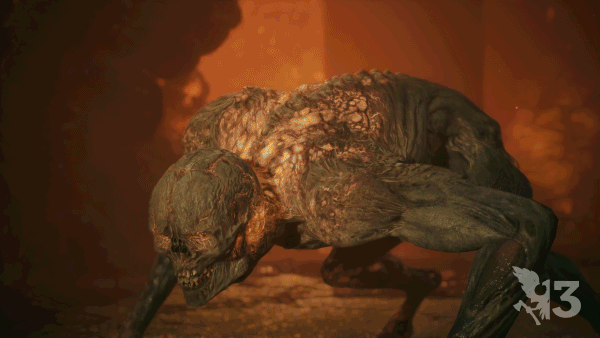
The goal was not simply to make a faster enemy. It was to create a threat that asks players to read, reposition, and make better decisions while preserving moments where they can recover and take control.
01 / THREAT ROLE
The Feral should be a problem the player cannot solve by casually backing away or repeating one safe action.
02 / READABILITY
Movement, attack timing, reactions, and sound all need to teach the player why the Feral is dangerous and when a response is possible.
03 / PACING
A disengage gives the player a breath to reassess while giving the Feral a stronger position to resume pressure.
PLAYER EXPERIENCE LOOP
COMBAT ITERATION
My first pass proved the idea before final dodge animation coverage was ready. The Feral could leave an exchange, find a better vantage point, and create a brief reset in the player’s decision making.
The current version turns that intent into a clean dodge. An EQS query searches an arc behind the Feral for a destination with line of sight, valid navigation, and useful distance from the player. From there he can return from a position that supports more dangerous attacks such as the flurry or lunge.
The player gets a moment to breathe and choose. The Feral gets a deliberate way to resume pressure without appearing to teleport out of danger.
PERCEPTION AS PERSONALITY
Different enemies should not share the same perception model. The Feral’s visual awareness is deliberately tight, so a careful player can move around the edge of his sight.
The tradeoff is hearing. His awareness rises extremely quickly when a player moves noisily within range. Crouching helps, but getting too close still triggers aggression. That reinforces his heightened senses and prevents a trivial sneak execution.
CONTEXT AWARE DEFENSE
The first vehicle dodge pass considered speed, direction, distance, a cooldown, and a chance gate. It proved the behavior but exposed a problem: a nearby vehicle moving parallel to the Feral could still trigger a dodge even when it was not a real threat.
The next refinement evaluates whether the vehicle is actually closing in. A dot product between vehicle velocity and the direction toward the Feral filters out harmless passes, letting him keep gaining ground instead of reacting to every nearby car.
I worked with the Vehicles team to expose the velocity data the AI needed through a blackboard value.
DESIGN TOOLS
I implemented noise debugging that visualizes the range of player generated sound. Instead of guessing why an AI reacted, designers can see the event, validate its reach, and tune it with confidence.
That shortens the path from something a player feels, to a clear hypothesis, to a better design decision.
AUDIO AS INFORMATION
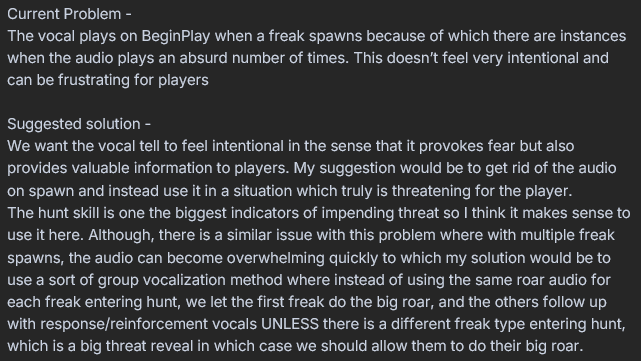
The existing spawn vocal could play once per audio instance, so several freaks appearing together could trigger the same sound repeatedly. It felt mechanical and quickly became overwhelming.
My solution was to move the major call to a threatening moment: when a freak enters Hunt after detecting the player. The first freak delivers the main roar, while others answer with shorter reinforcement calls. A different major freak can still have its own moment when the threat meaningfully changes.
The sound now has a job. It creates fear, tells the player pressure is building, and avoids turning an important cue into noise.
RISK READABILITY
The intention was to make decomposed zombies, plague zombies, and Bloaters the clear carriers of serious infection. Their heavy attacks can apply roughly 30 percent infection, making the source of danger easy to identify and important to prioritize.
I compared damage per proc, average damage per proc, attack duration, maximum accumulated damage, and the attack cycles needed to fully infect a player. That made it possible to tune the system around encounter risk instead of isolated numbers.
Players can learn which enemies demand space, which attacks cannot be ignored, and when infection focused consumables are worth using.
ALPHA READINESS
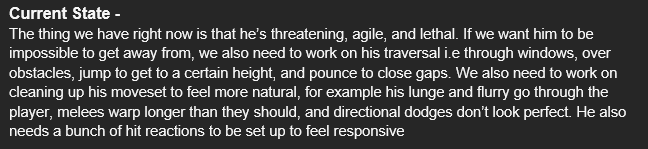
Before Alpha, the Feral already felt threatening, agile, and lethal. The remaining risk was consistency. Traversal needed to hold up through windows, obstacles, jumps, and pounces. Movement needed cleaner floor and ceiling handling. Melee warping, directional dodges, and hit reactions needed polish so the character felt responsive rather than unpredictable.
I used that gap analysis to separate work that protected the Feral’s core threat role from work that could wait for later polish. It gave design, animation, engineering, and QA a shared order of operations for getting the whole experience ready.
The work reinforced how much a memorable enemy depends on AI, animation, audio, feedback, and technical implementation telling the same story. My role was to keep those pieces aligned around a clear promise to the player.